
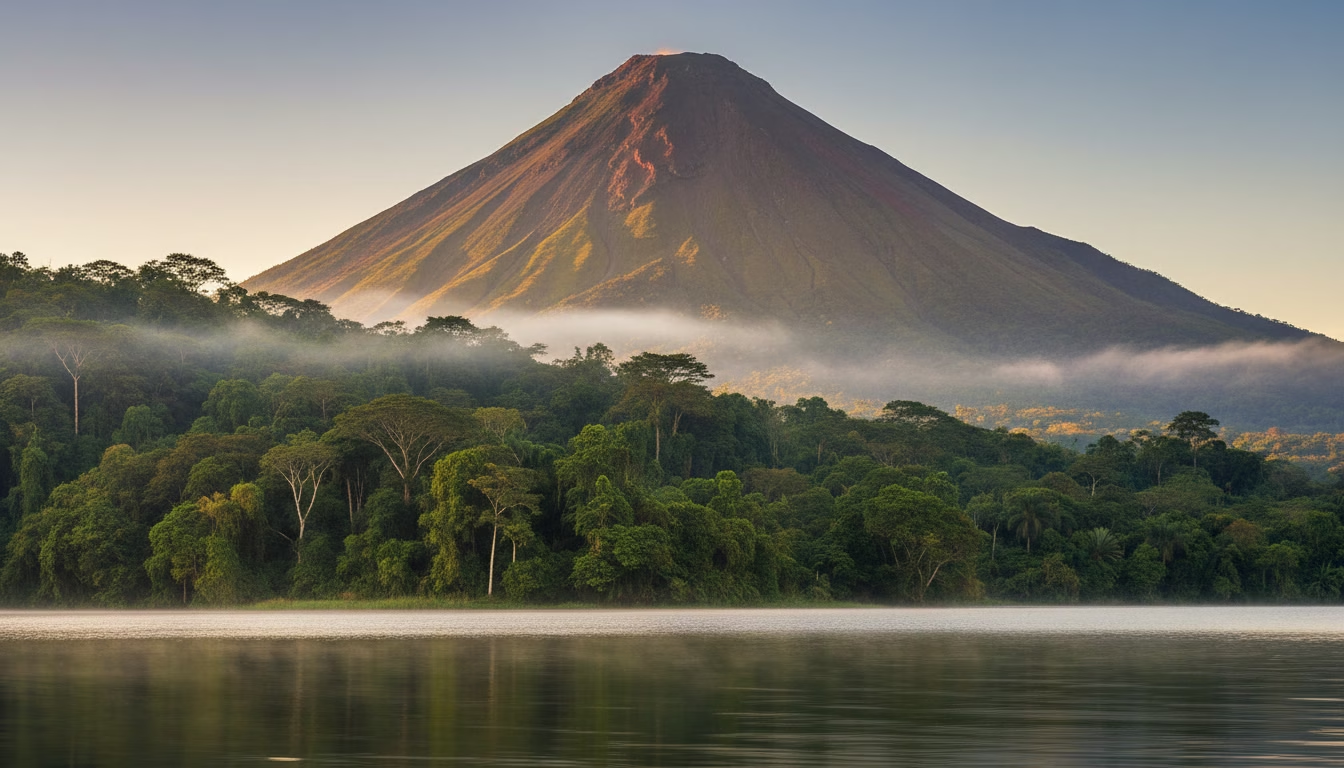
Arenal Volcano is one of the most iconic landmarks in Costa Rica. Its nearly perfect cone rises above the province of Alajuela, just a few kilometres from the lively town of La Fortuna. Whether you want to hike its slopes, admire its silhouette from the lake shore, or soak in the thermal springs that warm the entire region, Arenal offers a remarkable range of experiences in one place. This guide covers everything you need to plan your visit.
| Key detail | Practical information |
|---|---|
| Location | Province of Alajuela, San Carlos district, 15 km from La Fortuna |
| Distance from San José | About 80 km, roughly 2.5 hours by car |
| Volcano elevation | 1,633 metres |
| National park area | 12,080 hectares |
| Park opening hours | Every day from 8am to 4pm |
| Entrance fee | 15 USD adults / 5 USD children (2–12 years) |
| Best time to visit | December to April (dry season) |
| Volcanic activity | Dormant since 2010, last major eruption in 1968 |
| Can you climb to the summit? | No, access to the summit is forbidden |
| Recommended stay | 3 to 5 days to explore the whole region |
Where is Arenal Volcano in Costa Rica?
Location near La Fortuna and access from San José
Arenal Volcano sits in the north-west of Costa Rica, in the province of Alajuela, within the San Carlos district. It stands 15 kilometres from La Fortuna, the small town that serves as the base for virtually all visitors. From San José, the distance is roughly 80 kilometres, which translates to about 2.5 hours of driving through the country’s central highlands.
How to get to Arenal Volcano (car, bus, organised tours)
A rental car gives you the most flexibility. From San José, the main road passes through Ciudad Quesada. The bus is the most budget-friendly option, departing from the La Coca-Cola terminal in San José with several daily services and a journey time of around four hours. Local agencies also run organised excursions from the capital, with guide and transport included.
History and characteristics of Arenal Volcano
An active volcano from 1968 to 2010
Arenal lay dormant for more than four centuries before it suddenly woke on 29 July 1968. The eruption devastated several nearby villages, including Tabacon and San Luis, killing more than 80 people. For over forty years, Arenal was one of the most active volcanoes in Central America, regularly emitting lava and ash until it entered a new dormant phase in 2010.
Elevation, conical shape and volcanic landscape
The volcano reaches 1,633 metres in elevation and displays a remarkably symmetrical cone, a characteristic form of stratovolcanoes. This almost geometric silhouette makes it instantly recognisable. Around it, Arenal Volcano National Park stretches across 12,080 hectares of tropical rainforest, solidified lava flows and open terrain with views across the lake.
Why climbing Arenal Volcano is forbidden
Even in apparent dormancy, Arenal remains an active volcano whose behaviour can change without warning. Park authorities prohibit access to the summit for safety reasons, notably the risk of falling rocks, sulphurous gas emissions and unstable volcanic terrain. No trail leads to the crater, and this rule applies to every visitor without exception.
Visiting Arenal Volcano National Park
Opening hours, entrance fees and practical information
Arenal Volcano National Park is open every day from 8am to 4pm, including public holidays. Entrance costs 15 USD for foreign adults and 5 USD for children aged 2 to 12. Payment is made at the park entrance, usually by credit card. The park is divided into two distinct sectors, each with its own separate entrance.
The main hiking trails in the park
The Volcano sector has three marked trails. Las Heliconias trail (610 metres, flat) crosses a regenerating secondary forest. Las Coladas (1.7 km) leads to the 1992 lava flows. El Ceibo (2.3 km loop) takes you to a 400-year-old ceiba tree that survived the eruptions. In the Peninsula sector, Los Miradores trail (1.2 km) leads to a viewpoint with a view over Lake Arenal.
The lava flows of 1968 and 1992
Two lava flows can be reached on foot from the park. The older one, from 1968, covered dozens of square kilometres and is now visible as fields of black hardened rock. The 1992 flow, accessible via the Las Coladas trail, is a striking experience: you walk across a solidified, jagged, dark surface while vegetation slowly reclaims the ground around you.
The mirador and the best viewpoints over the volcano
The Peninsula sector’s mirador, reachable by car or on foot in about 1.5 hours, provides a clear view of the volcanic cone and Lake Arenal. Mirador 1968, located outside the park on Route 142, is also very popular for photographing the full massif. For the best chance of seeing the summit clear, arrive early in the morning before clouds wrap around the upper slopes.
What to do around Arenal Volcano: the essential activities
Hiking and observing tropical wildlife
Arenal Volcano National Park is home to 79 mammal species, including pumas, jaguars, Geoffroy’s spider monkeys and mantled howler monkeys. The trails also allow you to spot more than 370 bird species. Mornings are the most rewarding time: animals are most active between 6am and 9am, and the light is better for both watching and photography.
Hanging bridges and canopy exploration
Several private estates around La Fortuna offer hanging bridge circuits through the rainforest. The best-known, Mistico Arenal Hanging Bridges, takes you across 15 bridges along 3.5 km of trails in primary forest. You regularly encounter toucans, sloths and golden silk orb-weavers. A guided visit typically costs around 35 USD per person.
Zip-lining, canyoning and adventure activities
The Arenal area is prime territory for thrill-seekers. Zip-lining lets you fly over the rainforest canopy at dizzying heights, with several operators offering circuits above the lake or along the park’s edge. Canyoning in the local river gorges combines abseiling, jumps into natural pools and swimming. Pure Trek Canyoning is one of the most established agencies in La Fortuna.
White-water rafting on the Balsa and Sarapiquí rivers
The rivers flowing down the volcano’s flanks offer excellent rafting conditions. The Balsa River suits beginners well with its Class II and III rapids, while the Sarapiquí offers more technical sections for experienced paddlers. Descents generally last between two and three hours. Most La Fortuna agencies run trips with transfers and equipment included.
Night walks for wildlife spotting
The tropical forest takes on an entirely different dimension after dark. Guided night walks allow you to observe species rarely seen by day: red-eyed tree frogs, caimans along the riverbanks, kinkajous in the canopy and arboreal snakes. These night walks typically last about two hours and must be done with a local guide. Expect to pay between 25 and 35 USD per person.
Horse riding or mountain biking around the volcano
The rural tracks surrounding the volcano lend themselves to horse riding, with views across Lake Arenal and the green pastures of the San Carlos area. For a more energetic option, mountain biking lets you explore forest trails or ride along the lake shore for several kilometres. Several operators in La Fortuna offer both activities with equipment rental and guides included.
Natural sites to see near Arenal Volcano
La Fortuna Waterfall and its 70-metre drop
La Fortuna Waterfall, located 5 km from the town centre of the same name, plunges 70 metres into a cold-water pool surrounded by dense vegetation. To reach it, you descend around 500 steps from the paid entrance (20 USD for foreign visitors). The climb back up is more demanding. Swimming in the pool is allowed, provided you keep a safe distance from the base of the falls.
Lake Arenal, the largest lake in Costa Rica
Lake Arenal covers 85 square kilometres and is the country’s largest freshwater reservoir. It was created artificially in 1974 to feed a hydroelectric dam that now supplies around 70% of Costa Rica’s electricity needs. Its shores offer outstanding views of the volcanic cone, and the constant winds between November and April make it a popular spot for windsurfing and kitesurfing.
Cerro Chato volcano and its crater lake
Cerro Chato is an extinct volcano sitting in Arenal’s shadow, a few kilometres to the south-east. Its crater holds a turquoise-coloured lake of striking beauty, reached by a hike of around three hours return from Arenal Observatory Lodge. The trail is demanding, with very muddy sections in the wet season. Once you reach the crater rim, the view makes every step worthwhile.
Arenal’s hot springs
Why the region is so rich in thermal springs
The underground geothermal activity linked to Arenal Volcano heats the groundwater that flows through cracks in the volcanic bedrock. These waters rise to the surface at temperatures ranging from 37°C to 50°C depending on the site. Rich in minerals, they are valued for their therapeutic properties on muscles, joints and blood circulation.
Free natural springs and thermal spas
The range of options is wide. Rio Chollín, accessible on foot from Route 142 near the bridge opposite the Tabacón Resort, is a completely free natural spring mainly used by locals. For a more comfortable experience, Ecotermales Fortuna offers six pools at 37–41°C in a forest setting (around 45 USD per person). Baldi Hot Springs, with 25 pools and a lively atmosphere, suits families particularly well.
Where to stay near Arenal Volcano?
Hotels and lodges with a view of the volcano
Some accommodation enjoys a privileged position facing the volcanic cone. Arenal Observatory Lodge, located inside the national park itself, is one of the closest to the volcano and offers rooms with a direct view of its slopes. Tabacón Grand Spa Thermal Resort, 13 km north-west of La Fortuna, provides direct access to natural thermal springs from its gardens.
Accommodation in La Fortuna to suit every budget
La Fortuna has a wide range of options. Hostels offer dormitory beds from around 15 USD per night. Mid-range hotels such as Hotel Magic Mountain charge between 80 and 150 USD per night with a pool and open views. High-end eco-lodges around the lake frequently exceed 250 USD per night, with access to private thermal springs included.
Practical tips for visiting Arenal Volcano
What is the best time to see the volcano
The dry season, from December to April, gives you the best chance of seeing the summit clear. During the wet season (May to November), the volcano is often wrapped in cloud, sometimes for the entire day. That said, even in overcast conditions the region remains beautiful and forest activities are fully accessible. Mornings are generally the most favourable time, as clouds tend to build up during the afternoon.
What to pack for a visit or a hike
The humid tropical forest requires a few precautions. Bring a lightweight waterproof jacket even in the dry season, as sudden showers are common. Sturdy hiking shoes with good grip are essential on volcanic trails. Pack sunscreen, insect repellent and a water bottle too. There are no shops or drinking water points along the park’s trails.
FAQ about Arenal Volcano
Is Arenal Volcano still active?
Arenal has been considered dormant since 2010, when eruptions ceased. Geologists at Costa Rica’s Volcanological and Seismological Observatory (OVSICORI) continue to monitor it closely. It remains technically active, meaning it could reawaken in the future, but no eruptive activity has been recorded in recent years.
Can you see lava at Arenal Volcano?
Since 2010, it is no longer possible to observe molten lava. During the decades of intense activity (1968–2010), red-hot lava flows regularly descended the cone’s flanks, visible at night from several kilometres away. Today, the solidified flows of 1968 and 1992 can be visited on foot inside the national park and serve as vivid reminders of that period of volcanic fury.
How long should you allow to visit the Arenal region?
A minimum of three days is needed to visit the national park, hike to La Fortuna Waterfall and enjoy the thermal springs. To add adventure activities such as rafting, zip-lining and hanging bridges, plus exploration of the lake, five days makes for a more comfortable pace. The region is packed with things to do and deserves time spent without rushing.
Do you need a guide to visit the national park?
A guide is not compulsory for walking the trails of Arenal Volcano National Park. The rangers at the entrance hand out maps and basic explanations. That said, hiring a local naturalist guide greatly enriches the experience: they spot camouflaged animals, identify plant species and know which spots are most rewarding depending on the season. Several La Fortuna agencies offer this service from around 35 USD per person.