
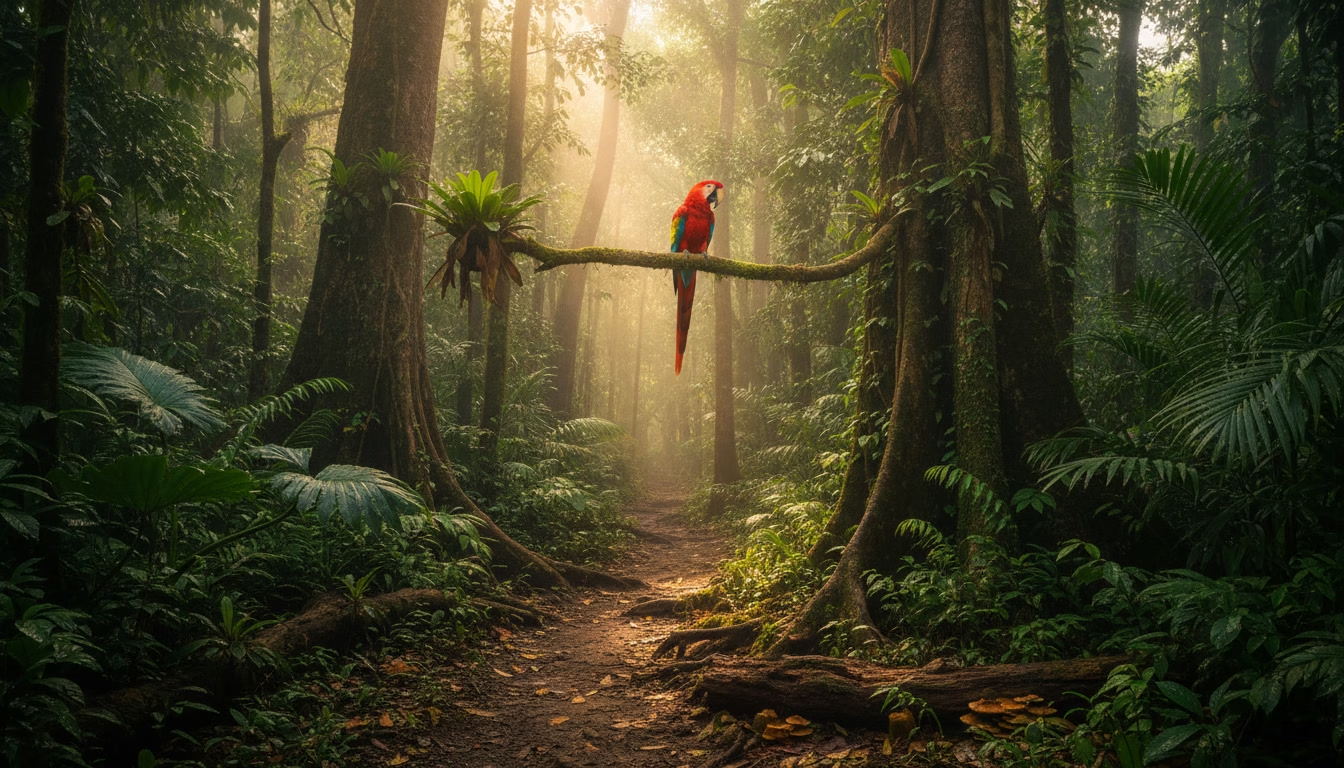
Carara National Park holds a unique place in Costa Rica’s natural landscape. Nestled on the Central Pacific coast, 90 kilometres from San José, this 5,242-hectare territory is home to the only transition forest on the Central Pacific, where the humid tropical forest of the south meets the dry forest of the north. This ecological singularity makes it a remarkable observation site, where the scarlet macaw reigns supreme and the crocodiles of the Tárcoles River are part of everyday scenery. Whether you are an experienced ornithologist or simply a nature lover, Carara Costa Rica is a stop that leaves a lasting impression.
| Criteria | Details |
|---|---|
| Location | Province of Puntarenas, 90 km from San José, 15 km from Jacó |
| Area | 5,242 hectares |
| Opening hours | Every day 7am to 4pm (closed Tuesday according to some sources) |
| Entry fee | ~$11.30 adult / ~$5.65 child (2–12 years) |
| Booking | Online at serviciosenlinea.sinac.go.cr (mandatory) |
| Emblematic species | Scarlet macaw (Ara macao) |
| Best period | December to April (dry season) |
| Main trails | Laguna Meándrica (2 km), Ará Macao (3 km), Universal Access (1.2 km) |
| Recommended duration | Half-day to full day |
| Wheelchair access | Yes, fully equipped universal trail |
Where Is Carara National Park in Costa Rica?
Location and Access from San José
Carara National Park is located in the cantons of Garabito and Turrubares, in the province of Puntarenas. From San José, allow around 1.5 hours by road, taking Route 27 towards Caldera then the Costanera Sur (Route 34) towards Jacó. The main park entrance is 2 kilometres south of the bridge over the Río Grande de Tárcoles, easy to spot from the road.
By bus, regular services from San José’s terminal head towards Jacó. Let the driver know to drop you at the park rangers’ post, roughly a 2-hour journey. By hire car, the route is straightforward and entirely paved: no 4×4 is required to reach the park.
A Park Situated Between Tropical Rainforest and Dry Forest
What makes this park so singular is precisely its geographical position. Carara marks the natural boundary between two biomes: the humid tropical forest typical of the South Pacific and the dry forest that dominates further north towards Guanacaste. This junction creates a hybrid ecosystem rarely observed elsewhere in Costa Rica.
Altitude ranges from 100 to 500 metres, generating distinct microclimates within the park. The Tárcoles River borders Carara park to the north, forming a natural boundary with its banks inhabited by crocodiles and waterbirds.
Why Carara National Park Is Unique in Costa Rica
An Exceptional Ecological Transition Zone
The scientific term used to describe Carara is “transition zone” or ecotone. Here, species typical of the dry forest cohabit with those of the humid forest, creating a biological density few places can match. This layering explains why scientists consider Carara national park a living laboratory for the study of tropical ecosystems.
Before being protected, the land belonged to the Gran Hacienda Coyolar, one of the largest private estates in Costa Rica. Established as a biological reserve in 1978, it was reclassified as a national park in 1998, formally recognising its extraordinary ecological value.
A Recognised Biodiversity Hotspot
The figures speak for themselves: Carara national park Costa Rica is home to 420 bird species, representing 47% of all species recorded in Costa Rica. The park also counts 112 mammal species, 124 reptile species and 62 amphibian species. These statistics make Carara one of the most biodiversity-dense parks in all of Central America.
International recognition matches this wealth. Carara features among the world’s leading ornithological destinations, attracting specialists from Europe, North America and Asia to observe species found nowhere else in such concentration.
Wildlife and Flora of Carara National Park
Spotting the Scarlet Macaw, Emblematic Species of the Park
The scarlet macaw (Ara macao, lapa roja in Spanish) is undoubtedly the park’s star. With its vivid red plumage streaked with yellow and blue, this spectacular bird measures up to 90 centimetres in length. A threatened species, it benefits from special protection at Carara, where breeding colonies have been rebuilt thanks to conservation efforts.
To maximise your chances of spotting one, arrive at the park’s opening time of 7am. Macaws are particularly active in the morning, moving in pairs or small groups towards fruit trees. The Tárcoles bridge, just north of the entrance, is one of the finest observation points in the region.
Mammals Present: Monkeys, Sloths, Anteaters
The park is home to several monkey species, including the howler monkey (mono congo), whose vocalisations echo at dawn and dusk, and the white-faced capuchin, more agile and often observed in groups in the canopy. Three-toed sloths, discreet but present, are best spotted with an experienced guide who knows exactly where to look.
Giant anteaters (osos hormigueros) frequent the park’s edges, alongside armadillos and agoutis. Ocelots and pumas exist in the park but are rarely visible. The vegetation density and nocturnal habits of these species make encounters exceptional rather than routine.
Reptiles and Crocodiles of the Tárcoles River
The Tárcoles River is one of the most crocodile-populated in all of Costa Rica. These reptiles, which can reach 4 to 5 metres in length, bask on the banks with disconcerting nonchalance. Beyond crocodiles, parque Carara hosts 124 reptile species, including green iguanas, basilisks (nicknamed “Jesus Christ lizards” for their ability to run across water) and several snake species.
Fer-de-lance snakes (Bothrops asper) are present in the park: a further reason to stay strictly on marked trails and watch where you step, especially after rain.
Rich Tropical Flora with More Than 1,500 Plant Species
Carara’s vegetation includes 480 documented plant species, of which 14 are endemic and 29 are considered rare. The broader floristic richness of the territory exceeds 1,500 species when peripheral areas are included. Giant ceibo and cedar trees dominate the canopy, while lianas, ferns and epiphytes cover every available surface.
On the Las Aráceas trail, you will encounter the Monstera deliciosa (the famous “Mano de Tigre”) whose broad, perforated leaves are adapted to capturing filtered light beneath the forest canopy. Anthurium and Philodendron of all forms colonise fallen trunks.
The Best Activities in Carara National Park
Hiking the Park’s Trails
Hiking remains the central activity at Carara. The park offers several trails of low to moderate difficulty, all well marked and accessible without specialist equipment. Most visitors combine two trails for a complete morning, starting with the Laguna Meándrica trail and then joining the trails from the visitor centre.
Slow, quiet walking is the key. The more quietly you move, the more the forest reveals itself: a translucent frog on a leaf, a trogon perched motionless two metres from the trail, an armadillo burrowing in the leaf litter without noticing your presence.
Birdwatching with a Naturalist Guide
Carara is one of the most renowned ornithological sites in Central America. With 420 recorded species, observation possibilities are vast, but a naturalist guide makes a radical difference. Local guides know which trees the macaws favour, the active times of toucans, and the precise spots where motmots nest.
Expect to pay around $60 for two people for a 2.5-hour session with a freelance guide at the park entrance. The investment is fully justified: without a guide, you will hear many birds you will never see. The spotting scope some guides carry transforms a distant coloured dot in the foliage into a striking close-up portrait.
Boat Safari on the Tárcoles River
Boat tours on the Río Tárcoles typically depart from the village of Tárcoles, at the river mouth a few minutes from the park entrance. This roughly 2-hour excursion allows you to approach crocodiles on their sandy banks, often just a few metres from the boat.
The late afternoon outing offers an added bonus: the golden light of the Pacific sunset. You will also encounter roseate spoonbills, herons, anhingas and, with luck, kingfishers plunging from branches overhanging the water.
Crocodile Watching from the Tárcoles Bridge
The bridge over the Río Grande de Tárcoles on Route 34 is one of the most photographed stops in Costa Rica. From the railing, you can look directly down at crocodiles resting motionless on the sandbars below, sometimes a dozen at once. The stop rarely takes more than 20 minutes but is worthwhile at any time of day.
A word of caution: traffic on the Costanera is heavy and fast. Park on the hard shoulder north of the bridge and cross carefully. Local stalls selling coffee and souvenirs are nearby.
The Main Hiking Trails of the Park
Sendero Laguna Meandrica Along the River
The Sendero Laguna Meándrica is a 2-kilometre linear trail that follows the Tárcoles River and leads to a meander forming a natural lake approximately 600 metres long and 40 metres wide. Walking time ranges from 2 to 4 hours depending on pace and stops to observe aquatic wildlife.
This trail has its own separate entrance, 2 km west of the main station, near the crocodile bridge on Route 34. Note: it closes systematically from September to October due to flooding caused by the Río Tárcoles rising, which can submerge the path under several metres of water.
Sendero Ará Macao in the Heart of the Rainforest
This 3-kilometre trail traverses the heart of the humid tropical forest from the main station. This is where the chances of spotting scarlet macaws are highest, particularly in the early morning. The trail is clearly marked and accessible to all fitness levels.
The closed canopy provides natural protection from the heat, making the walk pleasant even in the dry season. Trogons, motmots and brightly coloured tanagers are regularly spotted here. Allow around 1.5 to 2 hours to walk it at a leisurely pace.
Accessible Trail for Visitors with Reduced Mobility
The Sendero de Acceso Universal is a benchmark for accessibility in Central American national parks. Wide and entirely paved over 1.2 kilometres, it features nine rest areas with drinking water, rope railings, adapted toilets and Braille signage. Animal sculptures and an audio system complete the experience.
This trail is not reserved solely for visitors with mobility limitations. Even without physical constraints, the quality of the facilities makes it a genuinely pleasant walk, and macaws frequently fly over this section of the park in the morning. It connects to the Quebrada Bonita and Las Aráceas trails for a full loop from the main station.
When to Visit Carara National Park?
Best Period for Wildlife Observation
The ideal period runs from December to April, corresponding to the dry season on the Central Pacific coast. During these months, the trails are in better condition, animals concentrate around permanent water sources and visibility in the forest is greater, as trees in the dry zone shed some of their leaves.
Scarlet macaws are present year-round, but their activity is particularly intense between December and June, the nesting period. This is also the season when Tárcoles crocodiles are most visible on the banks, seeking to warm themselves in the morning sun.
Dry Season vs Rainy Season
The rainy season, from May to November, has an undeserved poor reputation. The forest turns an intense green, amphibians emerge in numbers after downpours and tourist footfall drops significantly. Fewer people on the trails means greater chances of spotting discreet mammals such as tapirs or anteaters.
That said, the Laguna Meándrica trail closes in September and October. Paths can be slippery after rain, and tropical afternoon showers, typically expected around 2pm, shorten the visiting window. Set off early, between 7am and 10am, to enjoy the best conditions whatever the season.
Practical Tips for Visiting Carara National Park
Opening Hours and Entry Fees
The park opens daily at 7am and closes at 4pm. Tickets must now be purchased exclusively online on the official SINAC website (serviciosenlinea.sinac.go.cr) since September 2023. The fee is approximately $11.30 per foreign adult and $5.65 for children aged 2 to 12. Children under 2 enter free but must still be registered.
It is strongly advisable to book the day before, or several days ahead during high season. Some international bank cards are accepted on-site, but paying online is the safer option to avoid any unpleasant surprises at the entrance.
Recommended Equipment for the Visit
Wear closed hiking shoes: trails can be muddy and the presence of snakes in low vegetation justifies protecting your ankles and feet. Light trousers and a long-sleeved shirt reduce insect bites without overheating. Binoculars and insect repellent top the list of essentials.
Bring sufficient water as there are no supply points inside the park (apart from fountains on the universal trail). A light waterproof jacket is useful even in the dry season, as sudden showers are never entirely ruled out. Leave no rubbish behind: no bins are provided on the trails.
How Much Time to Allow for the Visit
A half-day is sufficient to cover the trails from the main station. To combine both entrance zones (main station and Laguna Meándrica), allow a full day. Serious birdwatchers can easily spend 6 to 8 hours here. Arrive at opening time at 7am for the best observations, wildlife being noticeably more active in the early morning.
The park combines easily with an overnight stay in Jacó, 15 kilometres to the south, or with a visit to the Tárcoles bridge and a river safari in the afternoon. From San José, visiting Carara as a day trip is entirely feasible.
Sustainable Tourism and Conservation at Carara National Park
Protection of the Scarlet Macaw and Natural Habitats
The scarlet macaw population suffered a severe decline during the 20th century, primarily due to deforestation and wildlife trafficking. Conservation programmes carried out at Carara have enabled a slow but real recovery of the colonies. The park plays the role of biological corridor between fragmented habitats along the Central Pacific coast.
The SINAC (Sistema Nacional de Áreas de Conservación) manages the park and coordinates scientific research conducted on local wildlife and flora. Educational programmes are offered to Costa Rican schools to raise awareness among new generations of the importance of the region’s biodiversity.
Best Practices for Responsible Tourism
The park’s rules are simple but non-negotiable: stay on marked trails, never feed the animals, take nothing away, and carry all your rubbish out with you. Avoid excessive noise: a raised voice is enough to disperse wildlife over several dozen metres.
If you hire a guide, verify that they are certified by the ICT (Instituto Costarricense de Turismo). Official guides know the protocols for approaching wildlife and avoid behaviours that stress animals, such as shining a torch directly into reptiles’ eyes at night or approaching macaw nests.
FAQ About Carara National Park
How Much Does Entry to Carara National Park Cost?
Entry to Carara national park is set at approximately $11.30 per foreign adult and $5.65 for children aged 2 to 12. Tickets must be purchased in advance on the SINAC website (serviciosenlinea.sinac.go.cr). It is advisable to book ahead, particularly during the peak tourist season from December to April.
Can You Easily See Scarlet Macaws at Carara?
Carara is the most reliable site in Costa Rica for observing scarlet macaws in their natural habitat. The probability of spotting them is very high in the morning between 7am and 10am. They often move in pairs above the canopy with their distinctive calls. The Tárcoles bridge, just north of the park entrance, is an excellent free observation point accessible within minutes.
Is Carara National Park Worth Visiting on a Trip to Costa Rica?
Absolutely. Carara park offers a rare combination: accessibility from San José, exceptional biodiversity and well-maintained facilities. For a traveller crossing the Pacific coast between the capital and Manuel Antonio or Quepos, Carara is a logical stop that requires no detour. Even a two-hour visit on the Ará Macao trail justifies the stop.
Can You Visit Carara National Park in a Single Day?
Yes, a day trip from San José is entirely achievable. Leaving at 6:30am, you arrive at the park’s opening time, enjoy the best wildlife observation hours and return in the afternoon. It is even possible to combine the visit with a stop at the crocodile bridge and a boat safari on the Tárcoles River on the same day.