
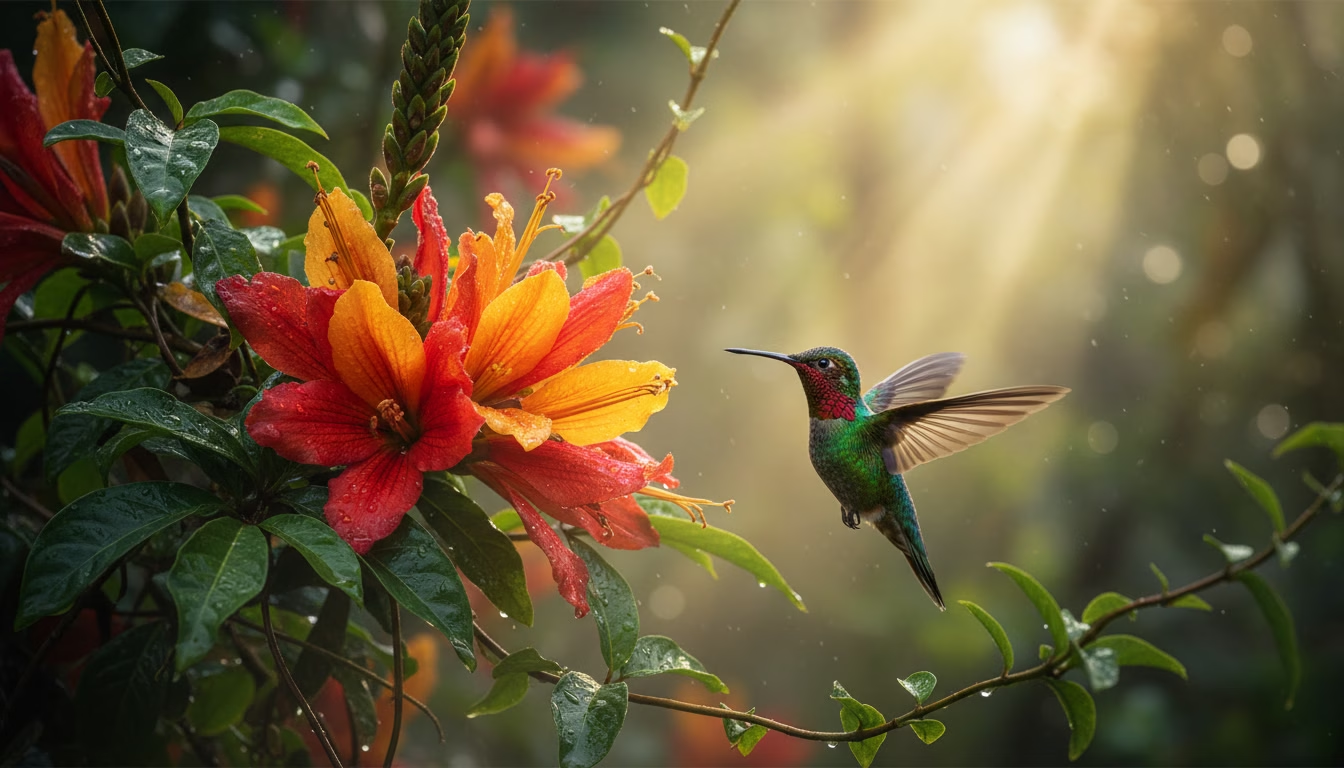
Costa Rica is one of the best places in the world to observe hummingbirds with remarkable ease and diversity. These tiny birds, capable of hovering flight and endowed with an extraordinary metabolism, are an integral part of the country’s forest ecosystems. Whether you are a seasoned ornithologist or simply a curious traveller, encountering them in their natural habitat is an experience that stays with you for a long time. To help you plan your birdwatching, here is a quick overview of the main species and best sites.
| Species | Approximate size | Main region | Altitude | Best period |
|---|---|---|---|---|
| Ruby-throated Hummingbird | 7 to 9 cm | Pacific Coast, Valle Central | 0 to 1,500 m | December to April |
| Rivoli’s Hummingbird (Magnificent) | 12 to 13 cm | Central Mountains, Talamanca | 1,500 to 3,000 m | Year-round |
| Violet-headed Hummingbird | 9 to 11 cm | Caribbean, Atlantic slope | 0 to 800 m | January to March |
| Cinnamon Hummingbird | 8 to 10 cm | Monteverde, San Gerardo de Dota | 1,200 to 2,500 m | November to May |
| Green Violetear (Colibri thalassinus) | 9 to 10 cm | Countrywide | 500 to 2,500 m | Year-round |
| Fork-tailed Woodnymph | 10 to 12 cm | Humid tropical forests | 0 to 1,000 m | December to March |
Why hummingbirds are iconic in Costa Rica
A symbol of Costa Rican biodiversity
Costa Rica holds nearly 5% of the world’s biodiversity within a territory the size of Wales. Hummingbirds perfectly illustrate this richness: more than 50 species have been recorded here, compared to just a handful in North America. Every forest, botanical garden and mountain trail offers a chance to spot at least one or two.
A fascinating bird for travellers and ornithologists alike
The hummingbird attracts nature enthusiasts and wildlife photographers in equal measure. Its ability to hang motionless in mid-air, the metallic sheen of its plumage and the speed of its movements make it a captivating subject to watch. In Costa Rica, ornithological lodges often set up dedicated feeders to allow observation from less than a metre away.
How many hummingbird species live in Costa Rica?
A country that is home to more than 50 species
Costa Rica officially lists between 52 and 54 hummingbird species, depending on the ornithological classification used. It is one of the Central American countries with the highest species density per square kilometre. Among them, some are endemic or near-endemic, such as the Talamanca Hummingbird, which is found nowhere else on Earth.
Distribution of hummingbirds by region and altitude
Hummingbirds are found across the entire Costa Rican territory, but their presence varies considerably with altitude. Lowland species inhabit coastal forests and wetlands between 0 and 800 metres. Others, adapted to the cold, live above 2,000 metres in the cloud forests of Chirripó and Talamanca.
The astonishing characteristics of hummingbirds
A tiny bird with an extremely fast metabolism
The size of a hummingbird varies between approximately 6 and 13 cm depending on the species. How much does a hummingbird weigh? Generally between 2 and 8 grams, roughly the weight of a sheet of paper. This diminutive size demands an exceptional metabolism: these birds consume the equivalent of their own body weight in nectar every day to maintain their energy levels.
Hovering flight and ultra-fast wingbeats
A hummingbird’s wingbeats are one of the most spectacular phenomena in the animal kingdom. The wing-flapping speed of a hummingbird ranges between 40 and 80 beats per second depending on the species. That amounts to between 2,400 and 4,800 wingbeats per minute. This frequency produces the characteristic humming sound that accompanies every one of their passes.
Impressive speed and agility
Hummingbirds can fly forwards, backwards, sideways and even upside down. Their cruising speed is around 40 km/h, but during courtship displays some males dive at more than 90 km/h. This agility allows them to reach the narrowest tubular flowers, inaccessible to other pollinators.
An extraordinary heart and brain
A hummingbird’s heart rate reaches around 1,200 beats per minute during flight, compared with 60 to 100 in a resting human. At night, in torpor, the hummingbird’s BPM drops to 50 or 60. Their brain accounts for 4.5% of their body mass, making it proportionally one of the most developed among birds, particularly for spatial memory.
Diet and lifestyle of hummingbirds
The essential role of flower nectar
The hummingbird feeds mainly on nectar, which it collects by inserting its long, slender beak into the heart of flowers. Its forked tongue extends up to twice the length of the beak to capture the sweet liquid. It visits between 1,000 and 2,000 flowers per day, enabling it to meet its considerable caloric needs.
Why hummingbirds also eat insects
Nectar alone is not enough to cover all of these birds’ nutritional requirements. Hummingbirds also hunt small insects and spiders to bring protein into their diet. Young birds in their growth phase receive a higher proportion of insects in their diet, which are essential for muscular development.
A constant energy requirement to survive
These birds cannot go without food for more than a few hours without serious risk. Their metabolic rate is so high that a single night without torpor would kill them from exhaustion. Nightly torpor, a state close to hibernation, allows them to reduce their metabolism by 95% and get through the night without eating.
The ecological role of hummingbirds in tropical forests
Essential pollinators for many plants
Hummingbirds pollinate a large proportion of tubular-flowered plants in Costa Rica’s tropical forests. As they move from flower to flower, they carry pollen on their beaks and foreheads. Certain plant species depend exclusively on hummingbirds for reproduction, creating an irreplaceable ecological bond.
A unique interaction between flowers and birds
The co-evolution between hummingbirds and tropical plants has produced remarkable adaptations. Red, orange or pink tube-shaped flowers are a direct invitation for these birds, whose colour vision includes ultraviolet. Some hummingbirds and certain flowers have developed perfectly complementary morphologies, with a beak and floral tube of identical length.
Where to observe hummingbirds in Costa Rica
Monteverde and its cloud forests
Monteverde is arguably the most accessible site for observing hummingbirds in their natural environment. The biological reserve and surrounding gardens host around a dozen species. The Hummingbird Gallery, right at the entrance to the reserve, offers feeders and a viewing terrace just a few centimetres from the birds.
San Gerardo de Dota and the central mountains
This mountain village, situated at around 2,200 metres altitude in the Savegre valley, is one of the best places in the country for observing high-altitude species. The resplendent quetzal is the star attraction, but high-mountain hummingbirds are equally present. The Albergue Mirador de Quetzales offers marked trails that are well frequented by ornithologists.
The surroundings of Poás Volcano
The area around Poás Volcano National Park, accessible in under an hour from San José, offers a fine diversity of species at altitudes between 1,800 and 2,700 metres. Farms and private gardens lining the access road frequently set up feeders. La Paz Waterfall Gardens, nearby, is a managed site where several species can be observed continuously.
National parks and nature reserves
Corcovado National Park on the Osa Peninsula is home to lowland species rarely seen elsewhere. Carara National Park, between the central Pacific and the Valle Central, forms a transition zone rich in varied species. Private reserves such as Tirimbina, in the Caribbean zone, organise dawn and nocturnal outings dedicated to birdwatching.
Tips for observing or photographing a hummingbird
The best times of day
Hummingbirds are most active early in the morning, between 6 and 9 am, and in the late afternoon, between 3 and 5 pm. These slots correspond to their feeding peaks. In the middle of the day, the heat drives them into the shade. Plan your observation outings from the very first hours after sunrise for the best chances of a sighting.
Using nectar feeders
Ornithological lodges in Costa Rica often set up dozens of feeders filled with red sugar syrup. These attract several species simultaneously and allow extended close-up observation. Bring lightweight binoculars with close-focus capability (less than 2 metres) to fully appreciate every detail of the plumage.
Techniques for successful hummingbird photography
Photographing a hummingbird requires a very short shutter speed, ideally below 1/2000th of a second, to freeze the wingbeats. Set your camera to shutter priority mode and raise the ISO as needed. Positioning yourself facing a feeder with the light behind you remains the most effective method for sharp, well-exposed shots.
Some surprising facts about hummingbirds
The smallest bird in the world
The Bee Hummingbird is the smallest bird in the world. It measures around 5 to 6 cm and weighs less than 2 grams. Although it lives mainly in Cuba rather than Costa Rica, it perfectly illustrates the incredible size variability within the trochilid family. In Costa Rica, the smallest species are around 7 cm long and weigh approximately 2.5 grams.
An exceptional heart rate
A hummingbird’s heart rate during exertion can reach up to 1,260 beats per minute, according to certain ornithological studies. By comparison, the human heart beats an average of 60 to 100 times per minute at rest. This exceptional cardiac frequency is directly linked to the energy required for hovering flight, a feat that very few animals are capable of replicating.
A unique mechanism for saving energy
Torpor is a physiological state unique to hummingbirds, similar to hibernation but limited to a few hours. Each night, their body temperature drops from 40°C to around 18°C. Their heart rate falls to around fifty beats per minute. Without this mechanism, they could not survive even a single night without food.
FAQ about hummingbirds in Costa Rica
How many hummingbird species can be seen in Costa Rica?
Costa Rica is home to between 52 and 54 recorded hummingbird species, depending on the ornithological source. This is one of the highest concentrations in the world for such a small territory. Some species are present all year round, while others are most easily observed between December and April, during the dry season.
What is the best time to observe hummingbirds?
The dry season, from December to April, offers the best observation conditions: less dense vegetation, clearer light and easier movement along trails. That said, hummingbirds are present throughout the year in Costa Rica. The flowering period of nectar-producing plants, which varies by region, often determines local population density.
In which regions of Costa Rica are they most numerous?
The Monteverde region, the Savegre Valley and the slopes of Poás Volcano concentrate the greatest diversity of species. The Osa Peninsula and the Caribbean zone are home to lesser-known lowland species that are equally spectacular. As a general rule, transition zones between two ecosystems offer the greatest species richness.
Why do hummingbirds beat their wings so fast?
The rate of wingbeats per minute in a hummingbird is directly linked to their distinctive flight style. Unlike other birds, they generate lift on both the downstroke and the upstroke, which requires an extremely high frequency. This mechanism allows them to maintain hovering flight while feeding on flowers.